
.png)
OVERVIEW
A PHYSICAL BARRIER AGAINST PARTICLES & BACTERIA
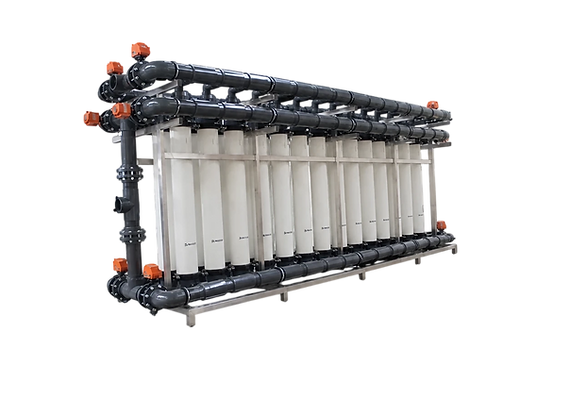
UF membranes have extremely fine pores that physically block suspended solids, bacteria and most viruses. The result is clear, low-turbidity water with stable quality, even when the raw water changes with the seasons.
UF can be used on its own for river and surface water, or as pretreatment before RO, where it protects the RO membranes better than media filters alone.
TYPICAL USES
- River and surface water treatment
- Pretreatment before seawater or brackish RO
- Water reuse after wastewater treatment
- Drinking water for communities
HOW IT WORKS
INSIDE THE UF SYSTEM
Raw water passes a strainer, then flows through UF membranes from the outside in. The membranes are backwashed automatically to keep them clean and the flow steady.
STEP 1
Raw water
Tap, well, river or sea
STEP 1
Raw water
River, well or seawater
STEP 2
Strainer
Removes coarse particles
STEP 1
Raw water
Tap, well, river or sea
STEP 3
UF modules
Outside-in membrane filtration
STEP 1
Raw water
Tap, well, river or sea
STEP 4
Automatic backwash
Keeps the membranes clean
STEP 1
Raw water
Tap, well, river or sea
STEP 5
Filtered water
Low turbidity, bacteria removed
KEY FEATURES
WHY CHOOSE OUR UF SYSTEMS
STABLE WATER QUALITY
Low turbidity even when the raw water changes.
IDEAL RO PRETREATMENT
Protects RO membranes and extends their life.
REMOVES BACTERIA
A physical barrier against bacteria and most viruses.
AUTOMATIC BACKWASH
Membranes clean themselves on a timer.
SMALL FOOTPRINT
Compact skids, or built into a container.
AUTOMATIC CONTROL
PLC control with alarms, so the system runs by itself.
SPECIFICATIONS
TECHNICAL DATA
The full model table, with capacities, number of modules and dimensions for each UF model, is in the datasheet.
Capacity range
1–5,000 m³/day
Feed water
River, well, seawater or treated wastewater
Membrane type
Outside-in UF modules
Cleaning
Automatic backwash + [CEB / CIP]
Format
Skid-mounted or containerized
APPLICATIONS
WHERE OUR RO SYSTEMS ARE USED