

Depth Filtration Systems
Slow sand, rapid gravity, and pressurized filters configurations, performance, and design selection
1. Depth Filters Overview
Depth filtration is a physical separation process in which water flows through a porous granular media bed, and suspended particles are retained throughout the entire depth of the filter rather than being restricted to the surface. This distributed particle capture mechanism allows progressive removal of contaminants as water moves through successive layers of media with varying pore spaces.
Depth filtration systems are widely implemented as a core component of multi-barrier water treatment trains. They serve as primary or secondary pretreatment units upstream of more sensitive processes such as membrane systems, where they reduce fouling potential and stabilize feed water quality. In addition, they are extensively used in potable water treatment plants for turbidity control and in industrial applications requiring reliable particulate removal and water polishing prior to process use or high-purity treatment stages.
One of the key advantages of depth filtration is its high solids holding capacity, which allows the filter to accommodate significant particulate loading before reaching terminal head loss. As a result, filters can operate for extended periods ranging from several hours to multiple days—before backwashing is required to restore permeability and hydraulic performance. This operational flexibility makes depth filters well-suited for variable influent conditions.

Filter Types
1. Slow Sand Filtration
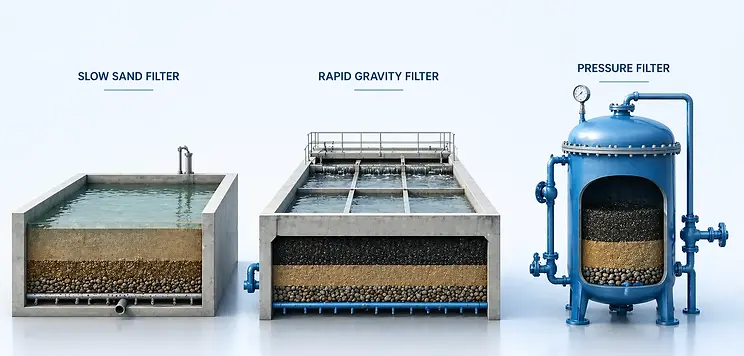
Slow sand filters are open concrete or earthen basins composed of a filtration tank filled with a granular media bed supported by a gravel layer at the base, an underdrain system for filtered water collection, and associated flow control and drainage components for operation and maintenance.
These systems are distinguished by their strong pathogen removal capability, which results from a combination of physical, chemical, and biological processes occurring within the filter bed. Key mechanisms include biological activity within the schmutzdecke layer, where microbial communities contribute through competition for nutrients and predation on pathogens.
Due to this integrated removal process, slow sand filtration can achieve highly effective water treatment performance in a single stage. It is applicable across a wide range of scales, from centralized municipal treatment facilities to small-scale and household water supply systems, particularly where low-energy, low-chemical treatment solutions are required.
A raw water turbidity of up to 10 NTU is generally recommended for slow sand filtration. For influent water with higher turbidity levels, pretreatment steps such as roughing filtration or assisted sedimentation are typically required to ensure stable operation and prevent excessive clogging of the filter bed.
Slow sand filters are capable of achieving effluent turbidity levels below 1 NTU while also providing high removal efficiency for pathogenic microorganisms. Reported performance includes greater than 95% reduction of bacteria and viruses, and more than 99% removal of protozoan organisms such as Giardia and Cryptosporidium.
The performance of slow sand filtration is influenced by several operational and design parameters, including sand effective grain size, filter bed depth, temperature, and water chemistry, particularly hardness. Sand characteristics are critical to filter performance, with an effective grain size typically ranging from 0.15 to 0.35 mm; smaller grain sizes generally result in higher removal efficiency but may increase head loss development.

Slow Sand Filter

2. Rapid Gravity Filters
Rapid gravity filters are open rectangular basins operating at 5–15 m/h — typically faster than slow sand filters. Rapid sand filters feature a tank or basin filled with filter media, supported by gravel at the base. They use coarser sand (effective size 0.45–0.55 mm), or dual media (anthracite over sand), to improve depth filtration and extend filter run length. Water flows downward by gravity into an underdrain collection system.
Rapid sand filters can operate standalone or alongside pre-treatment processes, based on raw water turbidity. They perform effectively at around 25 NTU. For higher levels, pairing them with a hybrid up flow roughing filter, or coagulation- flocculation treatment is recommended. In order to clean the media, backwashing can pump upward water flow and optional air scour to fluidize the bed. Backwashing reverses normal downward water flow, pumping clean water upward through the underdrain system into the filter bed.
This upward flow expands the media bed by 20-50%, fluidizing the sand grains to dislodge accumulated solids, which are then carried to overflow troughs at the top and discharged as waste.

Open rapid gravity filter basin

3. Pressure Filters
Pressurized sand filters are enclosed cylindrical vessels (FRP, stainless steel, or carbon steel) operating at 3–6 bar. Water flows downward through single-medium (sand), dual-medium (anthracite + sand), or triple-medium (anthracite + sand + garnet) beds.
Water enters the vessel under pressure with the aid of a feed pump, and percolates downward through multiple layers of coarse-to-fine sand. The filtered water exits at full operating pressure eliminating the need for a re-pressurization pump. Key components include the filter compartment(s), water inlet and outlet systems with controls, underdrain system for collecting clean filtrate, filter media, pumps (or elevated water tank), and an optional compressed air system for backwashing.
The filtered water is directed via the bottom drainage system to subsequent treatment stages. Over time, debris accumulates in the sand bed, necessitating periodic backwashing, during which water is pumped upward to fluidize and rinse the bed, dislodging trapped solids and restoring efficiency.

Industrial FRP pressure filter vessel

Comparative Analysis of Depth Filter Types

Design Guidance: Pressurized multimedia filters are the recommended choice for industrial and commercial RO pre-treatment applications due to their compact footprint, pressure-integrated operation, automated backwash control, and superior effluent quality versus gravity alternatives.