

Gateway to Filtration Media Mastering Physical Contaminant Removal
Types, properties, selection criteria, and applications of granular filter media for depth filtration systems
1. Filtration Media: Role in Depth Filtration
The performance of a depth filtration system is fundamentally determined by the choice of filter media. Media selection governs particle removal efficiency, head loss development, backwash requirements, filter run length, and media service life. In pressurized and gravity depth filters, granular media is placed in one or more layers within the filter vessel.
Each media type exhibits unique physical characteristics that determine its suitability:
-
Density: Affects buoyancy during backwashing; lighter anthracite expands more readily than denser sand, aiding effective cleaning.
-
Grain Size (Effective Size and Uniformity Coefficient): Effective size controls initial capture of larger particles, while uniformity coefficient ensures uniform bed porosity and minimizes channeling.
-
Hardness and Durability: High Mohs hardness resists attrition during repeated backwashing, preserving bed integrity over years of service.
Media choice must balance raw water quality with operational constraints like available head loss and backwash logistics. Proper sizing prevents breakthrough, emulsification, or mudball formation, ensuring consistent performance in applications from municipal plants to decentralized treatment units.
In essence, optimal media selection transforms depth filtration into a robust, low-maintenance process tailored to specific turbidity loads and site conditions.

Particle Removal Mechanisms
Depth filtration removes particles through five physical mechanisms acting simultaneously throughout the media bed:
-
Straining: particles larger than the pore space between grains are physically blocked within the bed.
-
Impaction: heavier particles cannot follow curved flow paths around media grains and collide with grain surfaces.
-
Interception: particles following streamlines contact media grains directly as streamlines pass close to grain surfaces.
-
Biological Growth: biofilms on media surfaces adsorb and biodegrade organic particles (particularly in slow filters).
-
Adsorption: fine colloidal particles are attracted and held onto media grain surfaces through electrostatic and van der Waals forces.

Types of Filter Media
1. Sand: Traditional Silica or Quartz Media
Silica sand is the most widely used filter media worldwide. It is dense (SG 2.60–2.65), hard, and chemically inert. It is mined, washed, classified and tested to AWWA B100 and EN 12904 standard. Could be used alone in mono-media sand filters or together with other media in multimedia sand filters.
-
Advantages: Low cost, universally available, long service life, proven performance, easy to specify.
-
Disadvantages: Heavy, high backwash velocity required; rapid surface blinding with high TSS feed if used alone.

2. Anthracite: Lightweight Coal-Based Media
Anthracite is a crushed coal media (SG 1.40–1.60) that forms the top layer of dual and multimedia filter beds. Its lower density means it stratifies above the denser sand during backwash, maintaining the coarse-over-fine arrangement that enables true depth filtration. Rough surface texture promotes particle adsorption and extends solids holding capacity. Conforms to AWWA B100 / EN 12909.
-
Advantages: Extends filter run time; low density, easy backwash; improves depth filtration when layered with sand.
-
Disadvantages: Softer than sand , some attrition over time; not suitable as sole media.

3. Garnet: High-Density Sand and Polish Media
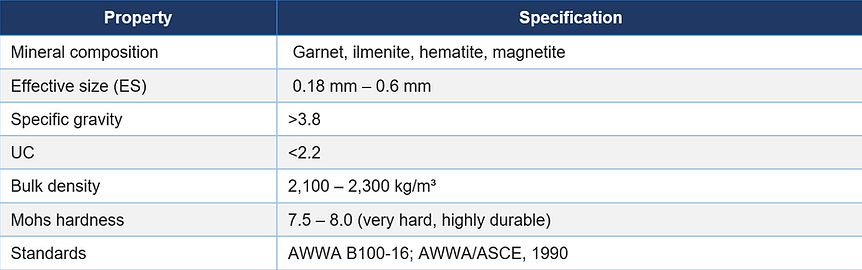
Garnet (SG 3.8–4.2) is used as the bottom polishing layer in triple-media filters. Its very high density ensures it stays below anthracite and sand during backwash. The fine grain size (0.2–0.4 mm typical) provides excellent final polishing. Conforms to AWWA B100.
-
Advantages: Finest conventional filtration layer in multi-media beds; very dense stays at the bottom; improves effluent quality and SDI.
-
Disadvantages: Highest cost of conventional media; not suitable as sole media; very high backwash velocity required.
4. Glass Media: AFM® (Activated Filter Media)
AFM® (SG 2.4 – 2.52 kg/L) is a modified recycled glass media with a permanently hydrophilic, negatively charged surface that enhances particle capture through electrostatic adsorption.
-
Advantages: Removes particles down to 1 µm; non-biodegradable (no biofilm risk); self-bacteriostatic surface; excellent SDI reduction.
-
Disadvantages: Higher cost; limited availability; requires compatible underdrain design.
5. Zeolite: Turbidex® Natural Mineral Media
Turbidex® is a naturally occurring zeolite mineral media (clinoptilolite, SG 2.2–2.4). Its unique surface charge and pore structure provide enhanced colloidal and fine particle removal compared to conventional sand. Particularly effective for SDI reduction ahead of RO membranes.
-
Advantages: High flow rate (up to 37 m/h); excellent SDI reduction; operates at 2–3× the flow rate of equivalent sand filter.
-
Disadvantages: Higher cost than sand; no resistance to microbial growth.
Mono-media Vs. Multi-media filters
Mono-media filters use a single graded sand layer, so most solids are trapped near the top of the bed, limiting full bed utilization. Multi-media filters use two or three layers of different media sizes and densities, which distribute particle capture through the full depth of the filter.
As a result, multimedia filters generally provide longer run times, higher solids loading capacity, and less frequent backwashing than mono-media filters.

comparison between mono-media and multimedia sand filters
When to Use Each Media : Selection Guide
Mono-media filters use a single graded sand layer, so most solids are trapped near the top of the bed, limiting full bed utilization. Multi-media filters use two or three layers of different media sizes and densities, which distribute particle capture through the full depth of the filter.
As a result, multimedia filters generally provide longer run times, higher solids loading capacity, and less frequent backwashing than mono-media filters.

Recommendation: For standard industrial and RO pre-treatment applications, a dual-media bed of anthracite (460–760 mm) over silica sand (150–300 mm) with a gravel support layer (300–560 mm) provides the best balance of performance, cost, and operational simplicity conforming to AWWA B100 and AWWA/ASCE design standards.