

Mastering Physical Water Quality
Parameters, Impacts, and Solutions
An engineering overview of turbidity, TSS, SDI, and microbiological indicators and why they matter
Why Water Quality Matters
Water is the foundation of every biological and industrial process. Whether used for drinking, agriculture, manufacturing, or energy production, the physical quality of water directly determines its suitability, safety, and cost of treatment.
Physical parameters turbidity, suspended solids, silt density, and microbial load govern how water looks, how it behaves in treatment systems, and how quickly it can foul membranes or endanger human health.

Physical Parameters Affecting Water Quality
1- Turbidity
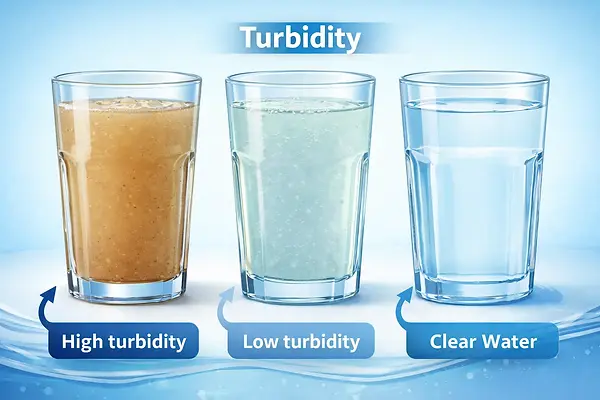
Turbidity is a fundamental water quality parameter that describes the optical clarity of water, resulting from the presence of suspended and colloidal particles that scatter light. These particles may include clay, silt, organic matter, microorganisms, and finely divided inorganic precipitates.
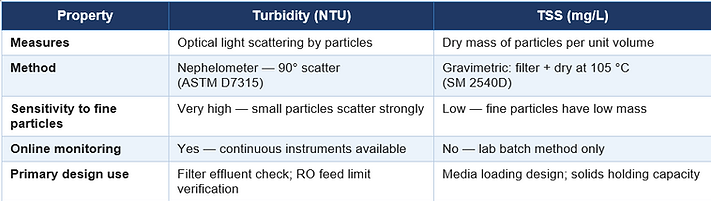
It is widely used in water treatment and environmental monitoring as an indicator of particulate content and overall water clarity, providing insight into the physical characteristics of the water. A nephelometer or turbidimeter passes a collimated beam of light through the water sample.
A photodetector positioned at 90° to the beam measures the intensity of light scattered by suspended particles. The reading is reported in NTU (Nephelometric Turbidity Units) or FTU (Formazin Turbidity Units equivalent to NTU). Continuous online turbidimeters install directly in the pipe and provide real-time monitoring of filter performance.
2- Total Suspended Solids (TSS)
TSS is a key physical parameter used to assess water quality and is usually expressed in milligrams per liter (mg/L). It is determined by filtering a known volume of water, drying the retained solids, and measuring their mass.
The TSS provides an indication of the particulate load in water and is commonly used in environmental monitoring and water treatment process evaluation. Therefore, it is a direct mass measurement that tells you how much solid material is in the water, not how much it scatters light.
Standard Method (SM 2540D) for measuring TSS:
-
A membrane filter (0.45 µm pore size, typically glass fiber) is dried at 105 °C for one hour and weighed on an analytical balance (precision ± 0.1 mg).
-
A measured volume of sample (typically 500 mL to 1,000 mL) is vacuum-filtered through the membrane.
-
The filter is returned to the oven at 105 °C for at least one hour, then cooled in a desiccator.
-
The filter is re-weighed.
-
TSS (mg/L) = (Final weight(g) − Initial weight(g)) × 1,000,000 ÷ Sample volume (mL).
3- Silt Density Index (SDI)
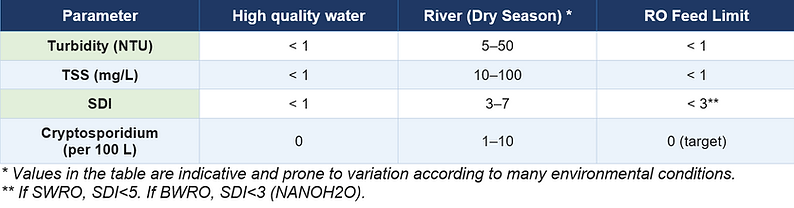
Silt Density Index (SDI) is an empirical parameter used to assess the fouling potential of water, particularly in membrane filtration systems such as reverse osmosis (RO). It measures the rate at which particulate matter in water clogs a standardized membrane filter under controlled conditions.
SDI values are dimensionless and provide an indication of the particulate fouling tendency of the feed water. Lower SDI values correspond to lower fouling potential, making SDI a widely used operational parameter in the design and monitoring of membrane-based water treatment systems.
Steps to measure SDI using ASTM D4189:
1. Force the sample water through a 0.45 µm membrane filter disc at a constant pressure of 30 psi (2.07 bar).
2. Record the time T₀ to collect the first 500 mL.
3. Allow filtration to continue for a total test time Tt (typically 15 minutes).
4. Record the time T₁₅ to collect a further 500 mL at the end of the test period.
5. Calculate: SDI₁₅ = [1 − (T₀ ÷ T₁₅)] × 100 ÷ Tt
4- Microorganisms
Waterborne pathogens such as Cryptosporidium, Giardia, bacteria, and viruses pose significant treatment challenges due to their wide variability in size, structure, and resistance to conventional disinfection processes.
Cryptosporidium oocysts and Giardia cysts are particularly critical, as they are highly resistant to chlorination and can persist in treated water if not effectively removed.
These protozoa are commonly detected using EPA Method 1623, which relies on immunofluorescence microscopy for accurate identification and enumeration. Due to their small size (typically 4–15 µm), physical removal through optimized coagulation, flocculation, and filtration is essential for effective control. Usually, a multi-barrier approach combining physical removal and robust disinfection strategies is necessary to ensure microbiological safety in drinking water systems.

Physical Parameters Affecting Water Quality
Affects Human Health: Turbid water shields pathogens from disinfection. Cryptosporidium and Giardia cause severe gastrointestinal illness. Most international regulations set drinking water turbidity limits at ≤ 1 NTU to protect public health.
Affects Aquatic Life: Suspended solids settle on riverbeds, smothering fish eggs and benthic organisms. Turbid water reduces light penetration, inhibiting photosynthesis and disrupting the aquatic food chain.
Premature fouling of RO membranes, ion exchange resins and UV disinfection systems
Abrasive wear in pumps, valves and heat exchangers when particles are hard minerals
Product contamination in food, beverage, pharmaceutical and microelectronics industries
Treatment of Physical Contaminants
Filtration is the primary technology for removing suspended solids, turbidity, SDI contributors, and microorganisms. The correct choice depends on feed water quality, effluent targets, flow rate, footprint, energy budget and downstream processes.
This section evaluates all principal technologies available for suspended solids removal, then presents the selection rationale for the pressurized deep-bed filter as the optimal solution for this application.
Three principal filtration mechanisms are applied in water treatment:
-
Depth Filtration: Water flows through a porous granular media bed where particles are retained throughout the entire depth of the media. Removal occurs through a combination of straining, interception, inertial impaction, and physicochemical interactions such as adsorption. This mechanism allows for high solids loading capacity and long filtration runs. Typical applications include rapid sand filters and multimedia filters, which are widely used as primary clarification and pretreatment steps.
-
Surface (Barrier) Filtration: particles captured on the surface of a screen or membrane with a defined pore size. This mechanism provides more predictable and consistent particle removal, particularly for larger suspended solids. However, it is generally limited by faster clogging and higher pressure drop buildup. Common examples include cartridge filters, bag filters, and disc filters, often used as polishing steps or as pretreatment prior to membrane systems.
-
Membrane Filtration: This process relies on pressure-driven separation across a semi-permeable membrane with well-defined pore structures. Depending on the membrane type (microfiltration, ultrafiltration, nanofiltration, or reverse osmosis), it can remove a wide spectrum of contaminants ranging from suspended solids to dissolved species. Ultrafiltration and Microfiltration act as effective physical barriers, capable of removing turbidity, colloidal matter, SDI-causing particles, and microorganisms including Cryptosporidium and Giardia. These systems are commonly applied in advanced treatment schemes, particularly where high-quality effluent or reliable pretreatment for reverse osmosis is required.
.webp)
Depth Filtration
(Pressure Sand Filter)
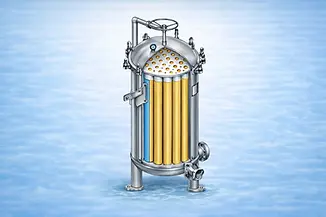
Surface Filtration
(Cartridge Filter Housing)
.webp)
Membrane Filtration
(UF module)
Key Principle: No single filtration technology addresses all physical contaminants in isolation. Effective water treatment trains combine depth filtration/ ultrafiltration, and fine barrier filtration in sequence each step reducing the load on the next.